
Navigating Revisional Powers: A Comparative Analysis of Section 263 of the Income Tax Act, 1961 and Section 377 of the Income Tax Act, 2025
Navigating Revisional Powers: A Comparative Analysis of Section 263 of the Income Tax Act, 1961 and Section 377 of the Income Tax Act, 2025
Introduction: In the Union Budget 2024-25, the Government announced a comprehensive review of the Income-tax Act, 1961, with the goal of making the law concise, lucid, and easy to understand. As a result, the Income Tax Act, 2025 has been enacted to streamline and modernize the direct tax framework in India. Among the numerous structural changes is the repositioning of the revisional powers of the tax administration. The power to revise orders prejudicial to the revenue, famously known under Section 263 of the old Act, has now been reincarnated as Section 377 in the new Act.
This article provides a comparative analysis of both sections, examining the differences in wording, the impact of the new enactment, and the crucial judicial precedents that remain firmly intact under the new regime.
Before moving forward, it is essential to trace the historical evolution of revisional powers within the Income Tax Law.
The history of revisional powers under Section 263 of the Income Tax Act, 1961, traces back to the earlier 1922 Act and is marked by continuous legislative amendments aimed at overcoming judicial limitations and plugging revenue leakage.
Origins under the 1922 Act: Prior to the Income-tax Act of 1922, there was no provision enabling the Revenue to revise assessment orders that were prejudicial to its interests. This omission was later addressed by inserting Section 33B into the 1922 Act via the Income-tax and Business Profits Tax (Amendment) Act, 1948, with effect from 30 March 1948. Section 33B granted the Commissioner the power to revise orders prejudicial to the interests of the revenue.
Transition to the Income Tax Act, 1961: When the Income Tax Act, 1961, was enacted, the powers under the old Section 33B were reincarnated as Section 263. Sub-sections (1) and (2) of Section 263 directly corresponded to the old provisions. However, the legislature proactively added a new sub-section (3) to overcome difficulties caused by the Bombay High Court's decision in CIT v. Kishoresinh Kalyansinh Solanki, specifically providing that the two-year time bar for revising an order would not apply when the revision is made to give effect to a finding or direction of an appellate authority or court.
Key Legislative Amendments to Section 263
Over the decades, Section 263 has undergone several critical amendments to broaden its scope and settle judicial controversies:
- The Taxation Laws (Amendment) Act, 1984:
- Scope of "Order": It inserted an Explanation to clarify that an "order passed by the Income-tax Officer" included assessment orders made on the directions of the Inspecting Assistant Commissioner (IAC) under Sections 144A or 144B, as well as orders passed directly by the IAC exercising the powers of an ITO.
- Reassessment Orders: It removed a previous ban, explicitly permitting the Commissioner to revise an order of reassessment made under Section 147.
- The Finance Acts, 1988 and 1989:
- Definition of "Record": Judicial controversy existed over whether the Commissioner could rely on new material that was not before the Assessing Officer (AO) at the time of assessment. An amendment clarified that the term "record" includes all records relating to any proceeding under the Act available at the time of examination by the Commissioner.
- Doctrine of Partial Merger: Courts were divided on whether an assessment order completely merged with an appellate order if an appeal was filed. The 1988 Act inserted an Explanation to clarify that the Commissioner is competent to revise an assessment order on all matters except those that were specifically considered and decided in an appeal. The Finance Act of 1989 subsequently clarified that these Explanations regarding "record" and "merger" were deemed to have always been in existence.
- The Finance Act, 2015: To curb the mechanical passing of orders by AOs, the legislature introduced Explanation 2 to Section 263(1). This introduced deeming fictions where an order shall be deemed to be "erroneous in so far as it is prejudicial to the interests of the revenue" if:
- The order is passed without making inquiries or verifications which should have been made.
- The order allows any relief without inquiring into the claim.
- The order is not in accordance with any order, direction, or instruction issued by the CBDT.
- The order is not passed in accordance with a binding decision of the jurisdictional High Court or Supreme Court.
- Recent Amendments (2020-2022):
- The Taxation & Other Laws Act, 2020 and Finance Act, 2021 structurally updated the authorities empowered to invoke this section, reflecting the newly designated hierarchy (e.g., Principal Chief Commissioner, Chief Commissioner, Principal Commissioner).
- The Finance Act, 2022 expanded the scope of Section 263 further by empowering the competent authorities to call for and revise orders passed by a Transfer Pricing Officer (TPO) working under their jurisdiction if such orders are found to be erroneous and prejudicial to the revenue.
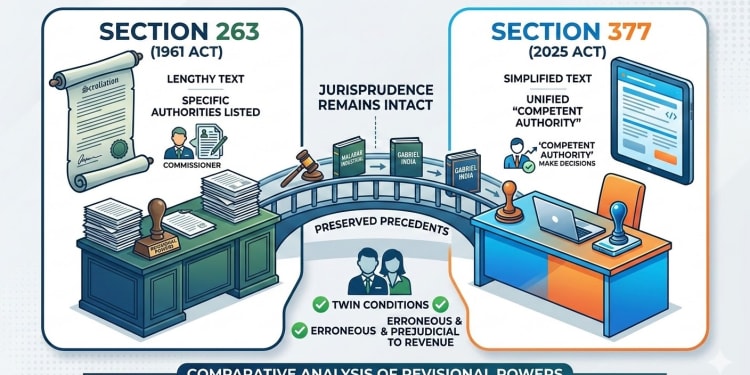
Comparison and Difference in Wording: A bare perusal of both provisions reveals that the essence of the law has been preserved, while the drafting has been simplified to eliminate repetitive jargon.
Under Section 263(1) of the 1961 Act, the provision read: "The Principal Chief Commissioner or Chief Commissioner or Principal Commissioner or Commissioner may call for and examine the record of any proceeding under this Act, and if he considers that any order passed therein by the Assessing Officer or the Transfer Pricing Officer... is erroneous in so far as it is prejudicial to the interests of the revenue, he may, after giving the assessee an opportunity of being heard... pass such order thereon as the circumstances of the case justify...".
Under Section 377(1) of the 2025 Act, the text has been condensed to read: "The Competent Authority may call for and examine the record of any proceeding under this Act, and if he considers that any order passed therein by the Assessing Officer or the Transfer Pricing Officer... is erroneous in so far as it is prejudicial to the interests of the revenue, he may, after giving the assessee an opportunity of being heard... pass such order thereon as the circumstances of the case justify...".
The primary difference lies in the replacement of the long list of specific tax authorities with the unified term "Competent Authority". Section 377(8)(a) of the new Act subsequently defines "Competent Authority" as the Principal Chief Commissioner or Chief Commissioner or Principal Commissioner or Commissioner. This structural modification achieves the Government's objective of textual simplification without altering the scope of the authorities empowered to invoke revision.
Impact of the New Enactment The transition from Section 263 to Section 377 is a textbook example of procedural simplification without substantive disruption. Because the foundational triggers for invoking the provision—namely, the order being "erroneous" and "prejudicial to the interests of the revenue"—have been retained verbatim, the entire established jurisprudence surrounding these phrases will seamlessly transition to the new Act. Taxpayers and tax professionals can safely rely on historical case laws, as the legislative intent and statutory limits of this supervisory power remain completely unchanged.
Old Judicial Precedents That Remain Intact Under Section 377: Since the core language of Section 377 mirrors Section 263, the following landmark judicial precedents will continue to serve as the guiding light for revisional proceedings under the new Act:
1. The "Twin Conditions" Principle The most fundamental rule of revisional jurisdiction is that the Commissioner cannot interfere simply because they hold a different opinion.
- Malabar Industrial Co. Ltd. v. CIT (2000) 243 ITR 83 (SC): The Supreme Court laid down that the twin conditions—(i) the order of the Assessing Officer must be erroneous, and (ii) it must be prejudicial to the interests of the revenue—must be satisfied concurrently. If an order is erroneous but not prejudicial, or prejudicial but not erroneous, it cannot be revised.
- CIT v. Gabriel India Ltd. (1993) 203 ITR 108 (Bom): The Bombay High Court emphasized that revisional power is supervisory in nature. The authority cannot set an order aside merely on a whim or caprice; there must be material on record to objectively satisfy the twin conditions.
2. Two Plausible Views Cannot Lead to Revision
- CIT v. Neena Krishna Menon (2021) 277 Taxman 211 (Karn) & Pawan Kumar v. PCIT (2024) 206 ITD 53 (Delhi Trib.): Courts have consistently held that if an issue is debatable and two views are possible, and the Assessing Officer has applied their mind and accepted one of the plausible views, the order cannot be deemed erroneous or prejudicial to the revenue. The Competent Authority cannot invoke Section 377 merely to substitute the AO's view with their own.
3. Doctrine of Partial Merger
- CIT v. Alagendran Finance Ltd (2007) 293 ITR 1 (SC): In cases where an assessment order is subject to an appeal, the doctrine of merger applies strictly to the issues that were actually considered and decided in the appeal. The Competent Authority retains the jurisdiction to revise the assessment order concerning issues that were untouched by the appellate authority.
4. Wide Amplitude of Revisional Power and Meaning of "Record"
- CIT v. Shree Manjunathesware Packing Products & Camphor Works (1998) 231 ITR 53 (SC): The Supreme Court ruled that the revisional power is of wide amplitude. The term "record" includes all records relating to any proceeding available at the time of examination by the Commissioner. Therefore, the Competent Authority is well within their rights to rely on new material that came on record after the original assessment was completed.
5. Requirement of Independent Application of Mind
- Karan Jain v. UOI (2024) 465 ITR 1 (Gauhati HC) & Dharmendra Kumar Bansal v. CIT (2015) 152 ITD 406 (Jaipur Trib.): Revisional proceedings cannot be initiated mechanically. If the Competent Authority initiates proceedings merely on the basis of a proposal sent by the Assessing Officer without an independent application of mind to record how the order is erroneous and prejudicial, such assumption of jurisdiction is void ab initio and illegal.
6. Object of Revisional Powers
- CIT v. Infosys Technologies Ltd. (2012) 341 ITR 293 (Karn): The objective of the provision is not to act as an appellate tool for the Revenue, but to plug the leakage of tax revenue caused by erroneous orders passed by lower authorities, whether due to mistake, ignorance, or design.
Conclusion The introduction of Section 377 in the Income Tax Act, 2025, in place of the erstwhile Section 263, is a welcome step towards linguistic simplicity. By substituting the exhaustive list of authorities with the term "Competent Authority," the statute has become cleaner and more readable. However, the substantive soul of the provision remains untouched. The guardrails built by decades of judicial wisdom—mandating the coexistence of "erroneous" and "prejudicial" elements, the protection of plausible views, and the necessity of independent application of mind—will continue to protect taxpayers from arbitrary administrative revisions in the new era of the 2025 Act.
SIMILAR ARTICLES