Choosing the Right NGO Structure in India: Charitable Trust vs. Section 8 Company Limited by Guarantee
EXECUTIVE SUMMARY
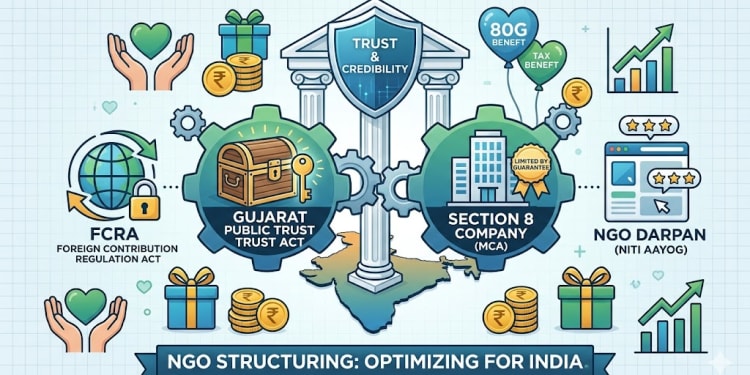
This memorandum presents a comprehensive comparative analysis of the two primary legal structures available for establishing your charitable initiative in India: (1) a Charitable Trust registered under the Gujarat Public Trusts Act (Bombay Public Trusts Act, 1950 as applicable to Gujarat), and (2) a Section 8 Company Limited by Guarantee registered under the Companies Act, 2013. Based on our research and analysis of current regulatory requirements, tax laws, and fundraising landscape, we provide a detailed pros and cons assessment for each structure, followed by a clear recommendation tailored to your objectives.
|
KEY FINDING: For an NGO seeking pan-India operations, corporate CSR funding, and long-term institutional credibility, a Section 8 Company Limited by Guarantee is the superior choice. Critically, by choosing 'Limited by Guarantee' (no share capital), the entity completely bypasses MCA Rule 9B's mandatory dematerialisation requirements — avoiding ₹30,000–₹45,000 in upfront and annual compliance costs. |
1. UNDERSTANDING THE TWO STRUCTURES
1.1 Charitable Trust — Gujarat Public Trusts Act, 1950
A public charitable trust is the oldest and most traditional form of NGO in India. In Gujarat, trusts are governed by the Bombay Public Trusts Act, 1950 (as adopted and modified by Gujarat), with the Charity Commissioner of Gujarat acting as the primary regulatory authority. A trust is formed through a Trust Deed executed on non-judicial stamp paper and is registered offline with the local Charity Commissioner's office.
A trust is not an independent legal entity in the way a company is — the trustees are personally linked to the trust and bear fiduciary responsibility. There is no concept of 'membership' in the corporate sense; governance rests with the Board of Trustees named in the deed.
1.2 Section 8 Company Limited by Guarantee — Companies Act, 2013
A Section 8 Company is a not-for-profit company incorporated under the Companies Act, 2013, licensed by the Central Government (Ministry of Corporate Affairs) to pursue charitable objectives. The term 'Section 8' refers to the section of the Companies Act that grants such companies special privileges including exemption from using 'Limited' in their name.
Crucially, a Section 8 Company can be structured in two ways: (a) Limited by Shares — where members hold shares of the company, or (b) Limited by Guarantee — where there is no share capital and members are bound by a fixed guarantee amount in the Articles of Association. The Limited by Guarantee model is the ideal choice for an NGO and forms the basis of this memorandum's recommendation.
2. MASTER COMPARATIVE ANALYSIS
The following table provides a feature-by-feature comparison across all critical parameters:
|
PARAMETER |
CHARITABLE TRUST (Gujarat CC) |
SECTION 8 — LIMITED BY GUARANTEE (MCA) |
|
Governing Law |
Bombay Public Trusts Act, 1950 (Gujarat) |
Companies Act, 2013 |
|
Regulatory Authority |
Charity Commissioner, Gujarat (State) |
Ministry of Corporate Affairs (Central) |
|
Jurisdiction / Reach |
Primarily local / Gujarat-centric |
Pan-India operational flexibility |
|
Legal Personality |
Not a separate legal entity; trustees are personally linked |
Distinct legal entity; perpetual succession |
|
Minimum Founders |
Minimum 2 Trustees |
Minimum 2 Directors (private) / 7 (public) |
|
Formation Document |
Trust Deed on Non-Judicial Stamp Paper |
Memorandum & Articles of Association (MoA / AoA) |
|
Registration Process |
Offline — Sub-Registrar or Charity Commissioner |
Online — MCA Portal (ROC filing) |
|
Share Capital / Demat |
Not applicable — no shares |
No shares (guarantee structure) — FULLY EXEMPT from Rule 9B Demat |
|
Property Transactions |
Requires prior written Charity Commissioner permission to sell / mortgage / lease |
Board Resolution sufficient; no govt. permission required |
|
Board Changes |
Requires court / CC approval for major changes |
Internal board resolution + ROC filing |
|
Dissolution |
Public trusts are generally irrevocable — cannot be easily dissolved |
Can be dissolved by MCA; winding-up provisions under Companies Act apply |
|
Corporate CSR Funding |
Moderate acceptance; some MNCs and tech CSR desks are hesitant |
Highest preference; actively sought by tech giants, MNCs, and CSR platforms |
|
FCRA Eligibility |
Eligible — separate FCRA registration required |
Eligible — separate FCRA registration required |
|
12A / 80G Registration |
Eligible for both; standard process |
Eligible for both; standard process |
|
12AB Registration |
Eligible |
Eligible — secure provisional registration immediately after incorporation |
|
Corpus Donations (Sec 11(1)(d)) |
100% tax-exempt with proper donor letter and investment in Sec 11(5) instruments |
100% tax-exempt — same conditions apply equally |
|
Deposit Rules Exposure |
No exposure — gifts and donations are not deposits |
No exposure — donations are non-refundable gifts; zero repayment obligation |
|
Annual Compliance Burden |
Low to Moderate (Annual accounts to CC, audit if income exceeds ₹5,000 — effectively all trusts) |
Moderate (Annual ROC filings, audit mandatory, XBRL for larger entities) |
|
Ongoing Cost |
Lower ongoing cost; no mandatory CS |
Higher; Company Secretary (CS) needed beyond threshold; annual filing fees |
|
Transparency / Credibility |
Moderate — older donors familiar; new-age CSR desks less comfortable |
High — ROC data is publicly accessible; preferred by SEBI-regulated listed company CSR committees |
|
Member Liability |
Trustees: unlimited personal liability in some scenarios |
Members: limited to guaranteed amount (typically ₹1,000 – ₹10,000 only) |
|
Amendment of Objects |
Requires Charity Commissioner approval + cy-pres doctrine may apply |
Special Resolution of members + ROC filing; more straightforward |
|
Income Tax Act 2025 (eff. April 2026) |
Trusts must now be irrevocable (codified in new ITA 2025) |
Not affected; companies have perpetual existence by default |
3. CHARITABLE TRUST (GUJARAT) — DETAILED PROS & CONS
3.1 Advantages of the Charitable Trust Structure
✔ Simpler and faster setup — registration is offline with the Charity Commissioner or Sub-Registrar; no MCA portal involvement and fewer technical compliance steps at formation stage
✔ Lower initial cost — no stamp duty on MoA/AoA; stamp duty on Trust Deed varies but is generally modest in Gujarat
✔ Lower ongoing compliance overhead — annual accounts to the Charity Commissioner and an audit (practically required for all trusts); no mandatory Company Secretary or ROC e-filing
✔ Deep legacy trust and familiarity — many religious donors, HNIs, and community foundations in Gujarat are culturally comfortable donating to trusts rather than companies
✔ Suitable for localized, community-level operations — if the NGO's work is entirely within Gujarat with limited ambitions to scale nationally, a trust structure is sufficient
✔ No shareholder or membership management — simpler internal governance without registers of members, transfer of membership, etc.
✔ Full eligibility for 12A, 80G, and 12AB tax registrations — same as a Section 8 company
✔ Full eligibility for corpus donation exemption under Section 11(1)(d) of the Income Tax Act — no structural difference from a Section 8 company in this regard
✔ Income Tax Act, 1961 (and the new ITA 2025 effective April 2026) — both trusts and companies enjoy similar tax treatment for charitable organisations
3.2 Disadvantages of the Charitable Trust Structure
✘ NOT a separate legal entity — trustees bear personal fiduciary liability; in extreme cases of breach, personal assets can be at risk unlike the limited liability protection in a Section 8 company
✘ Charity Commissioner permission mandatory for all property transactions — buying, selling, mortgaging, or leasing immovable property requires prior written permission; this creates significant delays and bureaucratic hurdles for operationally active NGOs
✘ Primarily state-level jurisdiction — the Charity Commissioner of Gujarat has authority only within Gujarat; running multi-state operations requires either additional registrations or a different structure
✘ Corporate CSR rejection risk — many large-cap companies, tech sector CSR committees, and multinational donor organisations specifically require Section 8 company status; some explicitly exclude trusts from their CSR disbursement policy
✘ Governance changes are cumbersome — amendments to the trust deed (including change of trustee or objects) require CC approval and potentially court involvement; this is significantly slower than a board resolution + ROC filing
✘ Irrevocability under the new Income Tax Act, 2025 (effective April 1, 2026) — trusts must now be constituted as irrevocable; while this is already the general principle under the BPT Act 1950, the new ITA codifies this, making trust dissolution even harder
✘ Perpetual oversight by Charity Commissioner — all major decisions remain subject to state regulatory oversight; this can slow strategic pivots
✘ Perception gap with new-age donors — younger HNI donors and impact investors increasingly prefer transparent, MCA-registered entities over the less digitally accessible trust structure
✘ Limited foreign funding (FCRA) optics — while FCRA registration is available to both, foreign donors and international foundations often prefer Section 8 companies for due diligence simplicity
4. SECTION 8 COMPANY LIMITED BY GUARANTEE — DETAILED PROS & CONS
4.1 Advantages of Section 8 Company Limited by Guarantee
✔ Complete dematerialisation exemption (Rule 9B) — because there is no share capital, there are no shares to dematerialise; the entity is fully outside the scope of MCA's mandatory demat notification (Oct 2023 and Feb 2025). Saves ₹15,000–₹25,000 in ISIN/RTA setup and ₹15,000–₹20,000 annually in PAS-6 filings
✔ Separate legal entity with perpetual succession — the company has its own legal identity independent of its directors; leadership changes do not affect legal continuity or ownership of assets
✔ Limited liability for members and directors — members' liability is limited to the guarantee amount (typically ₹1,000–₹10,000); personal assets are fully protected against organisational debts
✔ Pan-India operational jurisdiction — regulated by MCA (Central Government); the entity can open offices, receive donations, and operate in any state without additional structural registrations
✔ Highest CSR credibility — overwhelmingly preferred by SEBI-listed companies whose CSR committees require MCA-registered charitable entities; most tech companies and MNCs specify 'Section 8 company' in their CSR eligibility criteria
✔ No prior permission needed for property transactions — a board resolution is sufficient for buying, selling, mortgaging, or leasing property; no government approval needed
✔ Transparent and publicly accessible data — all filings are available on the MCA portal; this builds donor trust and satisfies institutional due diligence requirements
✔ Easier governance amendments — changes to objects, directors, or governance structure require a Special Resolution and ROC filing; no court or Charity Commissioner involvement
✔ Dissolution option available — unlike trusts, a Section 8 company can be wound up if required, providing strategic flexibility
✔ Eligible for 12A, 80G, 12AB, and FCRA — all tax exemption and foreign contribution registrations are fully available; no disadvantage vs. a trust
✔ Corpus donations fully exempt under Sec 11(1)(d) — identical benefit to a trust; 100% exempt from income tax if invested in approved instruments and properly documented with Corpus Letter
✔ Zero exposure to Companies Act deposit rules — donations are non-refundable gifts with no repayment obligation; cannot be classified as 'deposits' under Section 2(31); no DPT-3 reporting required for charitable receipts
✔ Preferred by grant-making foundations and bilateral aid agencies — many international foundations and USAID/EU-funded programmes require Section 8 company status
4.2 Disadvantages of Section 8 Company Limited by Guarantee
✘ Higher formation complexity — requires DIN, DSC, name reservation, MoA/AoA drafting, and MCA portal registration; more technical than a trust deed filing
✘ Higher ongoing compliance cost — mandatory annual audit, annual ROC filings (AOC-4, MGT-7), potential XBRL reporting for larger entities; a practising Company Secretary is required beyond certain thresholds
✘ Annual filing fees with ROC — government fees are payable on MCA portal for annual returns; not required under the trust structure
✘ Subject to Companies Act governance requirements — board meeting quorum rules, minutes maintenance, statutory registers must all be maintained rigorously; higher administrative burden than a trust
✘ Cannot pay dividends — any income must be reinvested towards charitable objects; this is a feature, not a bug for an NGO, but restricts the use of surplus
✘ Must include 'Foundation' / 'Association' / approved word in name — naming conventions are regulated; cannot freely choose any name
✘ Less familiar to traditional/religious donors — some community and religious donors in Gujarat may be more comfortable donating to a named trust than to a company, even a charitable one
✘ MCA oversight can be more formal — regulatory actions (if any) are governed by the Companies Act which has more defined penal provisions than the BPT Act
5. DEEP DIVE: DEMATERIALISATION (RULE 9B) AND WHY 'LIMITED BY GUARANTEE' IS THE SOLUTION
This section explains in detail why the choice of 'Limited by Guarantee' (rather than 'Limited by Shares') is a critical compliance and cost-saving decision for your Section 8 company.
5.1 What is MCA Rule 9B?
In October 2023, the Ministry of Corporate Affairs amended the Companies (Prospectus and Allotment of Securities) Rules, 2014 by inserting Rule 9B. This rule mandates that all private companies — other than small companies and government companies — must:
• Dematerialise all existing securities (shares, debentures, etc.) within the prescribed timeline
• Issue all future securities exclusively in dematerialised (digital) form
• File Form PAS-6 with the ROC within 60 days of the end of each half-year, detailing the dematerialisation status
The original deadline was 30 September 2024. MCA extended this to 30 June 2025. Post that date, non-compliance attracts penalties under Section 450 of the Companies Act, 2013.
5.2 Why Section 8 Companies with Share Capital are Affected
A Section 8 company is a type of private/public company. Crucially, Section 8 companies are explicitly excluded from the definition of a 'Small Company' under Section 2(85) of the Companies Act. This means even if a Section 8 company has minimal assets and turnover, it CANNOT claim the 'small company' exemption from Rule 9B. A Section 8 company with share capital is therefore fully subject to the demat mandate, including the cost of:
• Depository admission (NSDL/CDSL)
• ISIN (International Securities Identification Number) generation
• Registrar and Share Transfer Agent (RTA) fees
• Bi-annual PAS-6 filing with a practising Company Secretary
|
Cost Impact: ₹15,000–₹25,000 as one-time setup costs + ₹15,000–₹20,000 per annum in recurring compliance costs. Over 5 years, this amounts to ₹90,000–₹1,25,000 in pure avoidable expenditure for an NGO. |
5.3 Why 'Limited by Guarantee' Completely Eliminates This Problem
A Section 8 Company Limited by Guarantee has NO SHARE CAPITAL. Members are not shareholders — they are 'Guarantors' whose commitment is recorded in the Register of Members. Because there are no securities (shares or debentures) to dematerialise, Rule 9B has absolutely no application to such an entity.
|
Legal Confirmation: The Centre for Advancement of Philanthropy (CAP) has explicitly confirmed: 'A Section 8 Company limited by guarantee of its members is not required to do anything in this regard [Rule 9B demat mandate].' This is an absolute exemption, not a conditional one. |
The savings extend to Form PAS-6 as well — since there are no securities to report, this filing is entirely inapplicable. The member register is maintained as a simple Register of Members (physical or digital) under Section 88 of the Companies Act, which requires no depository infrastructure.
6. TAX & REGULATORY FRAMEWORK — APPLICABLE TO BOTH STRUCTURES
6.1 Section 12AB — Provisional and Final Registration
Both a Gujarat Charitable Trust and a Section 8 Company must obtain registration under Section 12AB of the Income Tax Act, 1961 to enjoy income tax exemption on their receipts. Provisional registration can be obtained within a few weeks of incorporation/registration and allows the entity to function with tax benefits immediately. A final registration under 12AB is obtained after 3 years of operation based on actual activity.
6.2 Section 80G — Donor Tax Deduction
Registration under Section 80G entitles donors (individuals and companies) to claim a 50% deduction on their donations (with qualifying limits). This significantly incentivises donations and is applicable to both structures equally. Note: 80G benefits are available ONLY for monetary donations (cash, cheque, NEFT/RTGS). Donations in kind — such as computers, equipment, land, or shares — do not entitle the donor to an 80G deduction, regardless of the entity's registration status.
6.3 Corpus Donations — Section 11(1)(d) Exemption
One of the most powerful fundraising tools for an NGO is the ability to build a corpus — a permanent capital endowment that generates returns to fund operations. Under Section 11(1)(d) of the Income Tax Act, donations made to the corpus of a registered charitable organisation are 100% exempt from income tax and are completely excluded from the mandatory 85% annual expenditure rule (Section 11(1)(a)).
Four conditions must be strictly complied with for this exemption to apply:
1. The entity must have valid 12AB registration
2. The donor must provide a signed 'Corpus Letter' specifically directing funds to form part of the corpus
3. The funds must be invested in approved instruments under Section 11(5) — such as FDs in scheduled banks, government securities, or other notified investments
4. If corpus funds are spent, they cannot be claimed as charitable expenditure unless replenished from regular revenues in a subsequent financial year
|
This benefit is identical for both a Charitable Trust and a Section 8 Company. There is no structural advantage for either form of entity in this regard. Choose the structure based on operational and fundraising considerations, not corpus tax benefits. |
6.4 Donations in Kind — Important Note for Donors
The entity is fully permitted to accept donations in kind (computers, servers, land, vehicles, etc.). However:
• The donor CANNOT claim Section 80G deduction for in-kind donations — this is a strict rule under the Income Tax Act applicable regardless of the receiving entity's structure
• The entity must record all in-kind donations at Fair Market Value (FMV) in its books of accounts
• All donated assets must be entered in the Fixed Asset Register and depreciated appropriately
6.5 Companies Act Deposit Rules — Zero Risk for Donations
Sections 73 to 76 of the Companies Act govern 'deposits' (money accepted from the public that creates a repayment obligation). There is zero risk that charitable donations constitute 'deposits' because:
• A 'deposit' under Section 2(31) is defined as a receipt that creates a repayment obligation — charitable donations have NO repayment obligation by definition
• Institutional, corporate CSR, and foreign donations (via FCRA) are explicitly excluded from the definition of 'deposit' under Rule 2(1)(c) of the Companies (Acceptance of Deposits) Rules, 2014
• Donations are credited to Capital Reserve/Corpus Fund in accounts — they are equity-like items, not liabilities, and therefore Form DPT-3 is not applicable
7. NEW INCOME TAX ACT, 2025 — IMPACT ON YOUR STRUCTURE
The Income Tax Act, 2025 (ITA 2025) has been enacted and will come into force on 1 April 2026. Key impacts on charitable entities:
• Trusts under ITA 2025 are required to be irrevocable — this is already the general principle under the Bombay Public Trusts Act, 1950, so this primarily codifies existing practice for Gujarat trusts rather than introducing a new restriction
• The overall tax exemption framework for registered charitable organisations (12AB / 80G / corpus under 11(1)(d)) is substantially carried forward in the new Act
• Section 8 companies are unaffected by the 'irrevocability' requirement — companies have perpetual succession by default and can be wound up through a defined process, giving greater strategic flexibility
|
Practical Impact: ITA 2025 does not materially change the tax advantages or disadvantages of either structure for new NGOs being set up in 2026. The recommendation remains unchanged. |
8. FOREIGN CONTRIBUTION (FCRA) — CONSIDERATIONS
If you plan to receive donations from foreign sources (including NRI donations from foreign accounts, grants from international foundations, or CSR from foreign-controlled companies in India), FCRA registration under the Foreign Contribution (Regulation) Act, 2010 is mandatory. Key points:
• Both a Gujarat Charitable Trust and a Section 8 Company are eligible to apply for FCRA registration
• FCRA registration is a separate central registration with MHA (Ministry of Home Affairs) and does not confer or remove any advantage between the two entity types
• However, in practice, MHA's due diligence process and international donor due diligence both tend to prefer MCA-registered Section 8 companies due to the availability of public filings and financial transparency
• Note: Donations from companies registered in India but with majority foreign shareholding are treated as 'foreign contribution' and require FCRA clearance regardless of which entity type you choose
9. OUR RECOMMENDATION
|
RECOMMENDATION We recommend incorporating a Section 8 Company Limited by Guarantee under the Companies Act, 2013. This structure offers the optimal combination of: pan-India operational credibility, maximum CSR fundraising appeal, limited liability protection for directors, complete demat exemption (Rule 9B), unrestricted property dealings, and full eligibility for all charitable tax registrations — at a compliance cost that is manageable and proportionate for a modern NGO. |
We specifically recommend the 'Limited by Guarantee' variant (no share capital) over 'Limited by Shares' for the following decisive reasons:
• Complete exemption from Rule 9B dematerialisation — no ISIN, no NSDL/CDSL, no PAS-6 filings
• Cleaner governance — membership is managed through a simple Register of Members; no complex shareholding structure
• Philosophical alignment — an NGO with no 'shareholders' is better positioned in its narrative with donors, government bodies, and the public
• Cost savings of ₹30,000–₹45,000+ over 5 years that can be redirected to charitable programmes
10. NEXT STEPS — INCORPORATION ROADMAP
Below is the recommended action plan for proceeding with the Section 8 Company Limited by Guarantee:
|
# |
STEP |
ACTION REQUIRED |
|
1 |
DIN & DSC |
Obtain Director Identification Numbers (DIN) and Class 3 Digital Signature Certificates (DSC) for all proposed Directors |
|
2 |
Name Reservation |
File RUN (Reserve Unique Name) application on MCA portal; include words like 'Foundation', 'Trust', 'Association', or 'Society' in name per Section 8 norms |
|
3 |
MoA & AoA Drafting |
Draft Memorandum of Association (objects clause) and Articles of Association with 'Guarantee' model articles; include the 'Securing of Funds' clause for corpus receipts |
|
4 |
Incorporation Filing |
File SPICe+ form on MCA portal with MoA, AoA, address proof, and director details; Central Government licence under Section 8 is issued alongside incorporation |
|
5 |
12AB Registration |
Apply for Provisional Registration under Section 12AB within 1 month of incorporation to enable immediate charitable tax exemption |
|
6 |
80G Registration |
File application for 80G approval simultaneously with or immediately after 12AB; enables donor tax deductions from day one |
|
7 |
Bank Account |
Open dedicated bank account in the company's name; maintain separate accounts for corpus and general funds per Section 11(5) requirements |
|
8 |
FCRA (if applicable) |
If receiving foreign funds, apply for FCRA registration with MHA after 3 years of operation (prior permission registration is available from day one for specific projects) |
11. WHEN A CHARITABLE TRUST MAY STILL BE PREFERRED
In the interest of providing a fully balanced analysis, a Gujarat Charitable Trust may still be the better choice if ALL of the following conditions apply to your situation:
• Your operations are exclusively within Gujarat with no plans for multi-state expansion
• You intend to draw donations primarily from community, religious, or traditional donor networks familiar with trust structures
• You do not intend to approach corporate CSR budgets (particularly from listed companies or MNCs)
• Your NGO will not require frequent property transactions
• You prefer minimal corporate compliance overhead and have no plans to scale significantly
• Your founding team is small (2–3 trustees) and prefers the informality of trust governance
In all other scenarios — particularly where CSR funding, institutional grants, or pan-India operations are contemplated — the Section 8 Company Limited by Guarantee is unambiguously superior.
|
DISCLAIMER This memorandum is prepared for the exclusive use of the named client and is based on the laws and regulations in force as of June 2026, including the Companies Act, 2013, the Bombay Public Trusts Act, 1950 (as applicable to Gujarat), the Income Tax Act, 1961, the Income Tax Act, 2025 (effective April 1, 2026), MCA notification on Rule 9B (October 2023 and February 2025), and the FCRA, 2010. This document does not constitute legal advice for any purpose other than the client's specific contemplated transaction. Laws are subject to amendment; readers should consult qualified legal and tax advisors before taking action. |
SIMILAR ARTICLES