Draft Foreign Investment Rules, 2026: What Replacing the NDI Rules Actually Changes

The RBI has proposed to compress a seven-year-old, schedule-heavy rulebook into nine rules and three annexures. The ambition is welcome. The drafting, in several places, is not yet ready — and one change quietly shifts a great deal of responsibility onto the valuer.
On 21 July 2026, the Reserve Bank of India released the draft Foreign Exchange Management (Foreign Investment) Rules, 2026 for public comment. The draft follows the Union Budget 2026-27 announcement of a comprehensive review of the Foreign Exchange Management (Non-debt Instruments) Rules, 2019, and the report of the committee constituted for that purpose. The comment window closed on 31 August 2026, which means the final rules are now being settled. This is the right moment to understand what is coming.
What follows is a clause-level reading of the draft from a practitioner's perspective — where it improves on the existing law, where the drafting creates exposure, and what a promoter group, a CFO or an NRI should be doing in the interval before notification.
The architectural shift
The NDI Rules, 2019 are organised around the investor. You begin by asking who is investing — a person resident outside India, an NRI, an OCI, a registered foreign portfolio investor, a foreign venture capital investor — and you are then routed to the schedule that governs that category. Ten schedules, each carrying its own permissions, pricing and reporting.
The draft abandons that entirely. It asks instead who is receiving the investment. Rule 2 applies the rules to any foreign investment in equity of an eligible investee entity by a person resident outside India, or transfer of it. Everything else follows from that sentence. Investor categories collapse into two: foreign direct investment at ten per cent or more, and foreign portfolio investment below ten per cent. FVCI, as a distinct regulatory species, is not carried forward.
This is a genuine simplification. For a client with a clean capital structure, it will cut advisory time meaningfully. But simplifying a rulebook is not the same as simplifying the law. What has actually happened is that detail has moved rather than disappeared — into Annexure-II (the FDI policy), Annexure-III (RBI regulations and directions), and into whatever the RBI later notifies on mode of payment and reporting. The nine rules read short because the hard parts now live somewhere else.
Why that matters: a rule in the gazette can only be amended by gazette notification. A policy annexed to it, and directions issued under it, move faster. If Annexure-II is treated as forming part of the rules, a question arises as to whether DPIIT press notes amending the FDI policy will require a corresponding amendment to the annexure. The final draft should say so expressly. This decides whether the FDI policy is law, or merely referred to by law — and that distinction determines what an adjudicating authority can enforce.
Four definitions that will generate most of the disputes
1. "Equity" now means whatever the accounting standard says it means
Rule 3(d) defines equity as instruments classified as equity by the eligible investee entity under applicable accounting standards, together with units of an investment vehicle and participating interests or rights in oil fields or mines of an Indian company or LLP.
Consider what that displaces. For over two decades, exchange control has told us what a non-debt instrument is: equity shares, compulsorily convertible preference shares, compulsorily convertible debentures, share warrants. A bright line, understood by every promoter, every fund and every authorised dealer bank.
The draft replaces the bright line with a characterisation exercise. Under Indian GAAP, classification follows legal form. Under Ind AS, it follows the substance of the return to the holder. A CCPS carrying a fixed dividend and converting at a formula price is equity under IGAAP and may sit as a financial liability under Ind AS until conversion. Same instrument, same term sheet, two answers — and the answer that governs FEMA now depends on which reporting framework the investee company happens to be on.
The position deteriorates when a company crosses an Ind AS applicability threshold mid-holding. Nothing about the investment changes, but its regulatory character does. There is also a direct collision with the borrowing framework, which treats optionally and partly convertible instruments as debt: the same instrument could be equity under these rules and external commercial borrowing under those. And the draft does not carry forward the convertible note mechanism that Indian startups have relied on since 2017, which matters to every founder raising a bridge round from a foreign angel investor.
My assessment is that this is the most consequential drafting choice in the document, and the cost outweighs the benefit. The instrument list should be retained. If the object was to future-proof the definition against new instrument types, a residuary limb achieves that. A regulatory boundary should not be outsourced to a financial reporting judgment made by a third party, after the transaction, on criteria that can change.
2. Control at ten per cent of voting rights
Rule 3(e)(B)(ii) introduces a look-through for indirect foreign investment. Where a non-resident invests through another non-resident that it owns or controls, or through one under common ownership or control with it, the investment is aggregated. The policy objective is legitimate: prevent a single beneficial owner from splitting a stake across several vehicles at nine per cent each to remain outside the FDI perimeter.
The calibration is the problem. Ownership is set at beneficial holding of more than fifty per cent. Control is defined to include arrangements entitling a person to ten per cent or more of voting rights. Two limbs of a single test, sixty percentage points apart. A shareholders' agreement conferring a ten per cent voting bloc becomes control for exchange control purposes while remaining nowhere near control under section 2(27) of the Companies Act, 2013 or under the SEBI Takeover Regulations.
India would then operate at least four working definitions of control — Companies Act, SEBI SAST, Competition Act and FEMA — with the FEMA threshold the lowest of them by a wide margin. Two corrections would resolve most of it. Align the voting rights limb with the majority standard already used in the ownership limb. And prescribe the date on which aggregation is tested; a threshold test with no measurement date invites dispute at every audit.
3. "Foreign controlled entity" delegated to sectoral regulators
Rule 3(h) provides that ownership and control of a foreign controlled entity will be governed by the provisions stipulated by the relevant sectoral regulator in consultation with the Central Government, and in the absence of such stipulation, by the Indian law under which the entity is incorporated.
The existing test — majority of capital together with majority of the board or of voting rights in non-resident hands — is blunt, but it is one test applied uniformly. Substitute a regulator-by-regulator determination and downstream investment analysis becomes sector-dependent. A group holding an NBFC, an insurance intermediary and a manufacturing arm could reach three different conclusions on identical shareholding. The fallback offers no relief: the LLP Act does not define ownership or control at all, so an LLP falls back to a statute that is silent on the question being asked.
Downstream investment is where mid-size Indian groups most frequently fall into inadvertent non-compliance, usually discovered years later during due diligence. Making the trigger less predictable moves in the wrong direction.
4. FDI and FPI defined purely by percentage
FDI is foreign investment of ten per cent or more in the equity of a company or an LLP. Foreign portfolio investment is less than ten per cent. Clean, and consistent with the IMF and OECD benchmark definition, which assists balance-of-payments measurement.
Two gaps follow. First, both definitions are framed by reference to a company or an LLP, while "equity" separately includes units of an investment vehicle. A non-resident holding units in an AIF, REIT or InvIT therefore fits neither definition on a literal reading. Defining foreign portfolio investment residually — any foreign investment that is not foreign direct investment — closes the gap in a single clause.
Second, the draft does not prescribe how ten per cent is computed where convertible instruments are outstanding. Fully diluted, as-converted at the maximum conversion ratio, or on the present cap table? A company with ratchet-linked CCPS can cross the threshold without a rupee of fresh investment. Prescribing a fully diluted basis assuming maximum conversion removes the ambiguity at no policy cost.
Pricing: an arm's length standard, and what it demands of the valuer
This is the provision I would ask every reader to sit with, because it changes the nature of the work rather than merely the number.
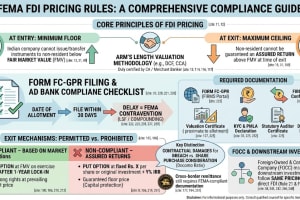
Rule 8(2) requires foreign investment and transfers to be priced under the relevant SEBI regulations for a listed company or an investment vehicle, under Annexure-I for a company listed on an international exchange, and in all other cases at a price determined as per any internationally accepted pricing methodology for valuation on an arm's length basis, duly certified by a Chartered Accountant, a SEBI-registered Merchant Banker or a Cost Accountant. Subscription to equity issued on a rights basis is carved out of pricing altogether.
Read the operative words carefully. Not "a" methodology. Not a prescribed methodology. Any internationally accepted pricing methodology, applied so as to produce a price on an arm's length basis. The regulator has deliberately declined to prescribe a formula. That is a considered liberalisation and, in my view, the right one — a discounted cash flow model is the correct tool for an operating business with visible cash flows and the wrong tool for an asset-holding company, and no single prescribed method can be right for both.
But liberty of method is not licence of method. The moment the rule stops prescribing, the burden of justification transfers wholly to the certifying professional. The certificate is no longer arithmetic confirmation that a prescribed formula was applied correctly. It becomes an assertion, made in the professional's own name, that the method chosen was appropriate to these facts and that the resulting price is one unrelated parties would have agreed. That is a materially heavier undertaking, and the profession should be honest with itself about the difference.
What "arm's length" actually imports
Arm's length is not a synonym for fair value, and it is not satisfied by producing a defensible number. It is a standard about the relationship between the parties, tested against a hypothetical transaction between unrelated parties dealing knowledgeably and at their own commercial risk. Three consequences follow that valuers underweight:
- Facts known to the parties are inputs. A promoter selling to a foreign strategic buyer who is paying for synergies is in a different position from a financial buyer. If the certificate ignores what the transacting parties knew, it is not testing the transaction that actually occurred.
- Adjustments must be identified, not absorbed. Discounts for lack of marketability, minority discounts, control premiums, holding company discounts — each must appear as a stated adjustment with a stated basis. A number that silently embeds a thirty per cent DLOC is not an arm's length determination; it is an opinion wearing a valuation's clothes.
- The standard is symmetric. Unlike the existing floor-and-cap approach, which permitted a resident to always receive at least fair value and pay no more than fair value, an arm's length test cuts both ways. A price well above the supportable range is as much a departure as one below it. Transactions structured on the old asymmetry should be re-examined.
The working paper is the compliance, not the certificate
If the rule is notified in this form, the exposure for a Chartered Accountant sits almost entirely in the file, not in the signed page. A certificate is one sheet. What defends it, years later, before an adjudicating authority, an assessing officer, a transfer pricing officer, or opposing counsel in a shareholder dispute, is the reasoning that produced it.
Generally;
- The principle framework sets the outer boundary. The ICAI Valuation Standards, the IVSC framework and the CFA body of knowledge define what is internationally accepted. A method outside that boundary is not defensible however sensible it appears, because the rule's own words tie acceptability to international acceptance.
- The circumstances of the subject eliminate methods, then rank them. First a hard elimination — an earnings-based method is unusable for a loss-making entity with no visible path to profitability; a market multiple approach fails without genuinely comparable companies; a DCF fails without a supportable forecast. What survives elimination is then ranked by fit: quality of available data, stability of margins, nature of assets, purpose of the valuation.
- Professional judgment operates only within the filtered set. Judgment applied before the filter is not judgment. It is preference, and preference is what an assessing officer will characterise as advocacy.
Advocacy bias is the real risk here, and it is worth naming. A valuer engaged by the party that benefits from a higher number will, without any dishonesty, tend to select the method that produces one. The regulatory answer to that has always been structural — registered valuer requirements, independence declarations, working paper mandates. Under a rule that prescribes no method, those structural safeguards carry more weight than ever, and the working paper carries most of it.
What a defensible FEMA valuation file should contain: the purpose, the standard of value and the valuation date, stated expressly; the information relied upon and its source, with management representations identified as such; every method considered — including those rejected; the reason each rejected method was rejected, tied to a specific fact about the subject rather than to convenience; the reason the selected method fits; each significant input with its derivation, particularly discount rate build-up, terminal growth and any multiple selected; sensitivity of the conclusion to the two or three inputs that actually drive it; every discount or premium applied, quantified separately with its basis; a reconciliation where more than one method was used, explaining the weighting; and the independence position of the certifying professional.
The rejection log is the part most often omitted and the part most often demanded later. A file that shows only the method used invites the obvious question: what would the answer have been under the method you did not use, and did you know that when you chose? A file that records the rejected methods and the factual reason for rejecting each one answers that question before it is asked. Under a rule that leaves method selection open, this ceases to be good practice and becomes the substance of the compliance.
One further point on the certifying pool. Extending certification to Cost Accountants alongside Chartered Accountants and Merchant Bankers widens capacity. It also widens the range of documentation practice attached to the same certificate. Where a certificate under this rule will be relied upon by an authorised dealer bank, in FDI reporting, and later in an income tax assessment on the same facts, the file behind it should be built to withstand the most demanding of those readers, not the least.
Two pricing gaps in the draft itself
Rule 8(2)(a) ties pricing to the SEBI regulations but says nothing about a price determined under a resolution plan approved under the Insolvency and Bankruptcy Code, 2016, or under a scheme sanctioned by a court or tribunal. A resolution plan price is not a negotiated price; it is the outcome of a statutory process with its own overriding effect. Requiring an independent arm's length certification over it creates a conflict between two statutes rather than resolving one. An express carve-out for prices determined under the IBC, or under any other law in force, is the clean fix.
Separately, the draft carries no exemption for a transfer between two persons resident outside India. Nothing about a sale from one foreign holder to another engages India's exchange position, and requiring an Indian valuation certificate for it imposes cost without regulatory purpose.
What the draft leaves out
The omissions are, in aggregate, larger than the amendments.
| Subject | Under the NDI Rules, 2019 | In the draft |
|---|---|---|
| Downstream investment compliance and reporting | Detailed provisions and Form DI | FCE defined; no operative downstream chapter |
| ESOP, sweat equity and employee benefit schemes | Expressly permitted with conditions | Absent |
| Merger, demerger and amalgamation of Indian companies | Expressly addressed | Absent |
| Acquisition and transfer of immovable property in India by non-residents | Within the NDI Rules | Absent; those rules being superseded |
| Convertible notes issued by startups | Defined and enabled | Absent |
| FVCI investment in specified sectors | Separate schedule | Category not retained |
| Escrow, deferred consideration, partly paid shares, warrants | Conditions prescribed in the rules | Left to RBI directions, not yet issued |
| Optionality clauses in FDI | Conditions prescribed | Absent |
| Reporting, KYC and FPI registration in unlisted companies and LLPs | In rules and directions | Left to RBI directions, not yet issued |
The immovable property omission affects the largest number of people. Every NRI who buys a flat, inherits agricultural land, or repatriates sale proceeds currently operates under provisions the draft proposes to supersede. If the replacement framework is not notified simultaneously, there will be an interval in which the governing provision for an entirely ordinary transaction is unclear. That is not a theoretical concern for a family that has already paid its stamp duty.
More broadly, a rulebook cannot be fully assessed when two of its three annexures have not been published. Consultation on nine rules, while the operative substance sits in unseen annexures and unissued directions, is consultation on the frame rather than the picture. Publishing the annexures and connected regulations in draft before notification would materially improve the final product.
The transition question, properly framed
The opening words supersede the NDI Rules, 2019 "except as respects things done or omitted to be done before such supersession". That formulation, reflecting section 6 of the General Clauses Act, 1897, is often read as full grandfathering. It is not, and the distinction carries real risk.
A saving clause of that kind protects acts. An allotment validly made in 2021 under Schedule I does not become invalid. What it does not obviously protect is a continuing state of affairs. Take an instrument issued in 2022 that was a non-debt instrument under the old definition but would be classified as a financial liability under Ind AS today. The issuance is saved. The holding is not an act; it is a status, and status is tested afresh under the new rules from the date they commence. The same difficulty arises for optionality clauses agreed under the earlier regime, for FVCI holdings once that category ceases to exist, and for group structures built on the current FCE test.
The remedy is a single express transition clause: foreign investment made in accordance with the NDI Rules, 2019 or the erstwhile FEMA 20R or FEMA 20, read with the FDI policy then applicable, shall be deemed to be in compliance with these rules and may continue to be held and transferred on the terms on which it was made. One sentence, and it would prevent a decade of avoidable compounding applications.
What the draft gets right
It would be unfair to catalogue only the difficulties. Several changes are straightforwardly good:
- Non-repatriation investment is largely freed. Rule 8(3) exempts it from the conditions in Rule 8, subject only to the prohibited sectors. That is the correct treatment for what is functionally domestic capital.
- Direct overseas listing is codified. Annexure-I consolidates eligibility, pricing, voting rights and the permitted transfer-back events — delisting, an IBC resolution plan, buy-back, merger, and transmission on succession — into one instrument instead of a scatter of notifications.
- Rights issues are carved out of pricing. Sensible, since the price is offered to all shareholders on identical terms.
- IFSC financial institutions are carved out entirely, deferring to the IFSCA regime rather than layering two regulators over one transaction.
- The onus of compliance is stated expressly in Rule 9, on both the foreign investor and the Indian investee entity. Clients rarely enjoy hearing it, but an explicit allocation of responsibility is better than an implied one.
- The permission route is consolidated. Rule 5 sets a clear default — no foreign investment except as provided — with a single power in the RBI to permit otherwise on application. That is a cleaner architecture than the current patchwork of specific approvals.
On the division of powers in Rule 4, with the RBI administering the rules and DPIIT owning interpretation of the FDI policy, I am less troubled than some commentators. Locating policy interpretation with the department that writes the policy is coherent. What is missing is process: a stated turnaround, a published response, and a mechanism by which a DPIIT interpretation binds authorised dealer banks. Two doors with no corridor between them is the problem, not two doors.
What promoters, CFOs and NRIs should do now
The rules are not notified. The NDI Rules, 2019 remain in force until they are. But the direction of travel is clear enough to act on, and the interval before notification is exactly when preparation is inexpensive.
- Re-examine every convertible instrument on the cap table. Ask your auditor, in writing, how each is classified under the applicable accounting framework and what would change on an Ind AS transition. If the FEMA character of an instrument will follow its accounting classification, you need to know today what that classification is.
- Map the group's foreign shareholders for common ownership and control. Two or three apparently unrelated foreign holders sitting under a common ultimate owner may aggregate past ten per cent under the new look-through, converting portfolio holdings into FDI with sectoral caps, entry route conditions and reporting attached.
- Re-run the downstream investment analysis. If the FCE test becomes sector-specific, an Indian subsidiary currently outside the downstream net may not remain there.
- Upgrade the valuation file before you need it. If a valuation supporting a live or contemplated transaction does not record the methods rejected and why, it is not yet built for an arm's length standard. Rebuilding it now costs a day; reconstructing it during an assessment costs considerably more.
- Do not sign a share purchase agreement on a pricing mechanic that assumes the current floor and cap. Long-stop dates are running into the notification window. Build a change-in-law provision addressing the pricing standard specifically.
- NRIs with property transactions in progress should track the immovable property replacement framework closely and, where timing is flexible, prefer completing under the existing rules.
- Regularise historical non-compliance now. A compounding application under a known regime is a better proposition than one filed after supersession, when the applicable standard becomes an additional argument you have to win.
Frequently asked questions
Are the NDI Rules, 2019 still in force?
Yes. The Foreign Exchange Management (Foreign Investment) Rules, 2026 are a draft. Until they are notified in the Official Gazette, the NDI Rules, 2019 continue to govern foreign investment in India in full.
What is the biggest single change in the draft Foreign Investment Rules 2026?
The definition of equity. Moving from a fixed list of instruments to classification under applicable accounting standards changes how every convertible instrument in India is characterised for exchange control purposes.
How will FDI pricing work under the draft rules?
For unlisted companies, the price must be determined under any internationally accepted pricing methodology for valuation on an arm's length basis, certified by a Chartered Accountant, a SEBI-registered Merchant Banker or a Cost Accountant. No specific method is prescribed, which places the burden of justifying the method selected — and the methods rejected — on the certifying professional's working papers.
Does the ten per cent FDI threshold mean small foreign investors escape the FDI policy?
No. Rule 8(1)(a) applies entry routes, sectoral caps and sectoral conditions to foreign investment generally, not only to FDI. The ten per cent line principally determines classification, reclassification and reporting treatment.
Do the draft rules cover acquisition of immovable property in India by NRIs?
No. The draft addresses foreign investment in equity of eligible investee entities. Provisions on immovable property currently within the NDI Rules are not carried forward, and the replacement framework has not yet been published.
Will an existing FDI structure need to be redone?
Usually not the structure itself. The exposure is to characterisation — whether an instrument, a holding or a group's aggregate stake is classified differently under the new definitions. For most groups this is a review exercise rather than a restructuring exercise.
The short version
The RBI set out to make India's foreign investment rulebook shorter, more principle-based and easier to navigate, and on architecture it has largely succeeded. What the draft has not yet done is match that simplification with certainty. An equity definition resting on an accounting judgment, a control test carrying a ten per cent limb and a fifty per cent limb in the same paragraph, a foreign controlled entity test delegated across sectoral regulators, and nine subjects left to annexures not yet published — each trades a page of drafting for a year of interpretive dispute.
The pricing provision is the exception that proves the design can work. By declining to prescribe a method and requiring an arm's length outcome instead, the RBI has given the profession room to apply the right tool to the right business. That room is only worth having if the reasoning behind the choice is written down at the time it is made. Under this rule, the working paper is the compliance.
SIMILAR ARTICLES